Cigarette Vending Machines and Taspo Cards in Japan
Taspo stopped working on 31 March 2026. Here is what cigarette vending machines in Japan accept now, and why tourists cannot use them.
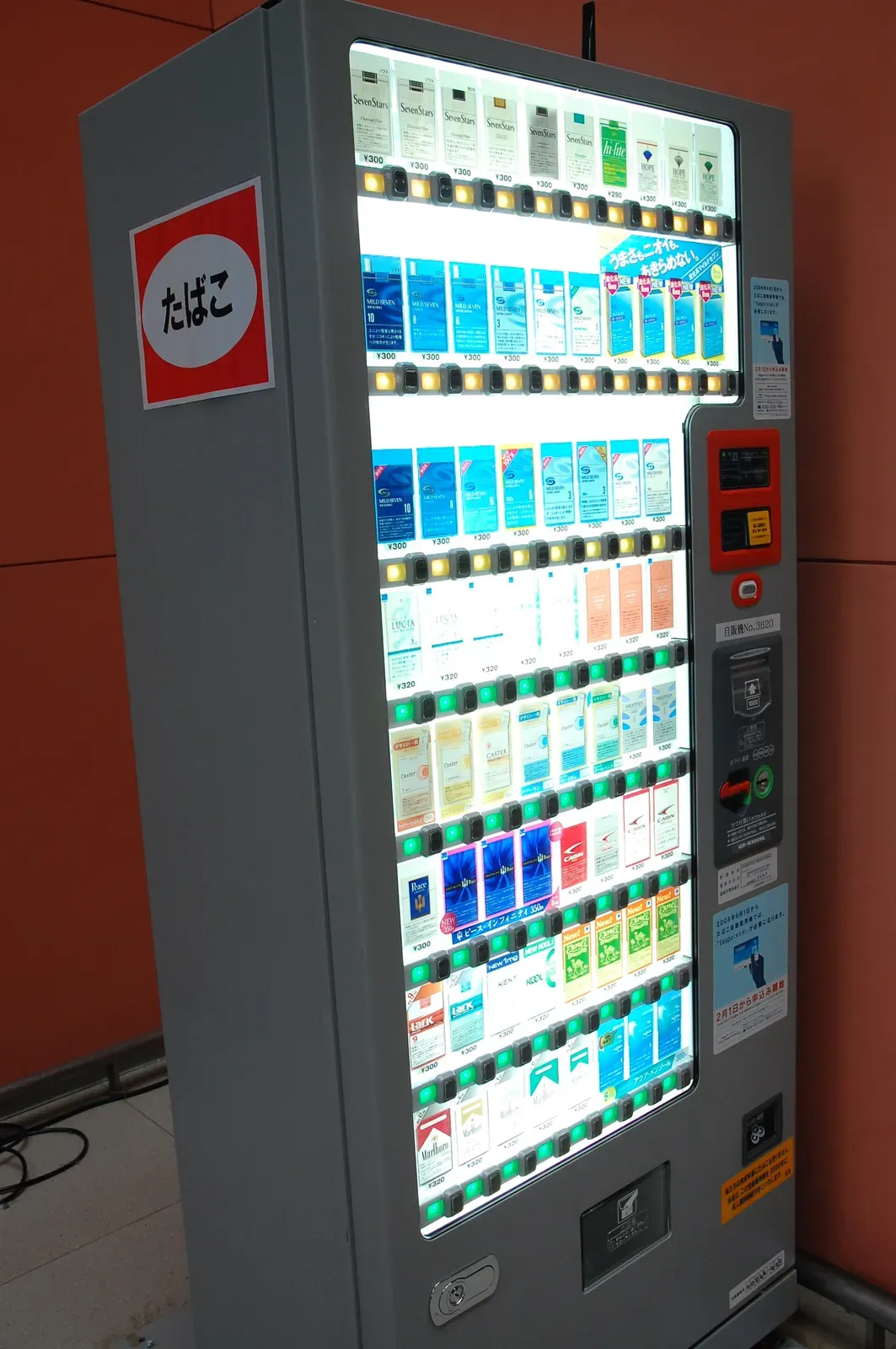
Cigarette vending machine in Japan 20071228.jpg
Photo: chou_i_ci · Wikimedia Commons
CC BY 2.0 Modified
Tourists cannot use cigarette vending machines in Japan. Taspo, the card that used to let anyone use these machines, stopped working completely on 31 March 2026 — so this is no longer just a tourist problem, it applies to Japanese residents too. Buy cigarettes at a convenience store instead — every visitor can do that regardless of what card or ID they’re carrying.
Taspo is gone, not just hard to get
Taspo ended on 31 March 2026, when NTT Docomo shut down the FOMA mobile network the card system depended on for age checks.12 Every Taspo card became invalid at that point, including ones held by Japanese residents who had used them for years.
The numbers show how far the card had already fallen out of use before the shutdown. Japan issued more than 10 million Taspo cards since the system launched in July 2008, but by the time the service ended, 90% of those cards were no longer being used.6 At the end of 2025, only around 50,000 vending machines nationwide still had active Taspo usage on record.6
No new cards, no exceptions: Taspo stopped accepting new applications on 30 September 2025, six months before the shutdown.2 Not a foreign resident of Japan, not a Japanese citizen — nobody has been able to get a Taspo card since.
You may still see old Taspo stickers and signs on vending machines or outside tobacco shops around Japan. That doesn’t mean the machine works — the notices from these venues just haven’t been taken down.
What the machines accept now
A small number of cigarette vending machines are still running, and Japan’s Ministry of Finance keeps an official list of which age-check methods are approved for them.3 Here is what actually works, as of the current list:
| Document | Who has it | Works in a vending machine |
|---|---|---|
| Japanese driver’s license | residents who drive | Yes |
| My Number Card | registered residents, including foreign residents | Yes, on newer machines |
| Japanese Residence Card | foreign residents | No |
| Foreign driver’s license | tourists and foreign residents | No |
| Foreign ID card (e.g. a US state ID) | tourists | No |
| Foreign passport | tourists | No |
| Taspo card | nobody — discontinued | No |
The machine works by reading a birth date stored on the document itself: insert the card into a reader on the machine, and it checks whether you’re 20 or older before letting the sale go through. That only works for the two document types on the list. A foreign passport, foreign driver’s license, or foreign ID card isn’t something the machine recognizes as an input at all — it isn’t a case of the machine reading it and rejecting you, the reader has nothing to do with it.
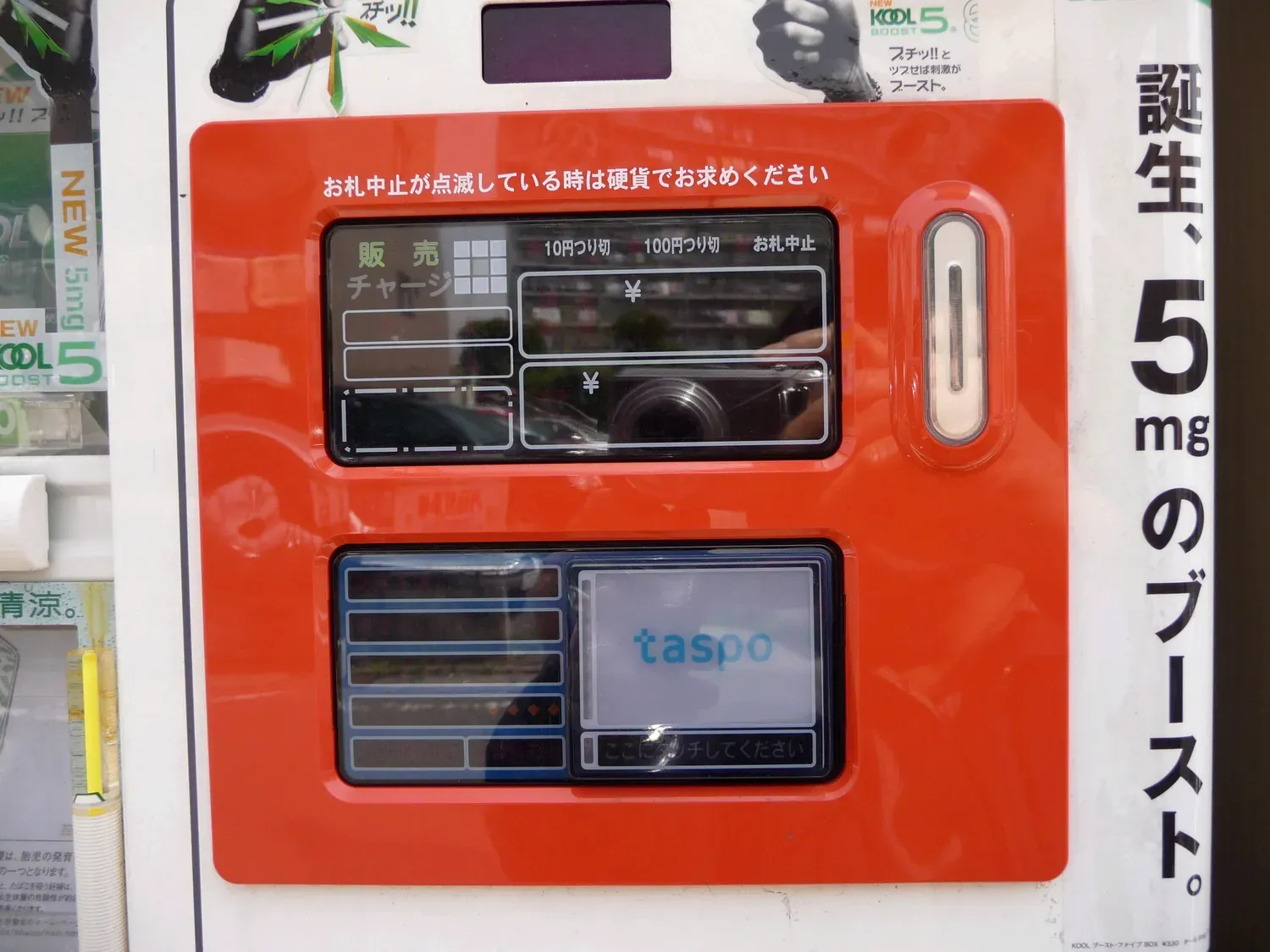
This is what a Taspo reader looked like. The orange panel with the "taspo" screen is where you tapped the card, next to the coin slot. Machines that survived the shutdown had this unit disabled or removed.
Facial recognition and foreign passports: tried, mostly abandoned
Japan looked at two other ways to check age at a vending machine, and it’s worth knowing about them mainly so you don’t go looking for a machine that will take your passport.
In June 2024, the Ministry of Finance approved a passport-reading method: a device that scans the IC chip built into a passport and checks the birth date on it, the same way the driver’s license and My Number Card readers do.4 In principle, this should work with any passport that has a chip, foreign or Japanese. In practice, machines built for this method were never deployed at any real scale. If you’re picturing a vending machine in Japan that takes your passport, it doesn’t exist in numbers you’d actually run into.
Japan also approved facial recognition for a period, where a camera on the machine estimated whether the buyer looked 20 or older. This method is only recognized today for machines that were already installed by 22 December 2015 — it was never expanded past that.3 A machine using it still doesn’t check your nationality or read any document, but it doesn’t matter either way: almost none of these machines are still running. You are very unlikely to ever come across one at all.
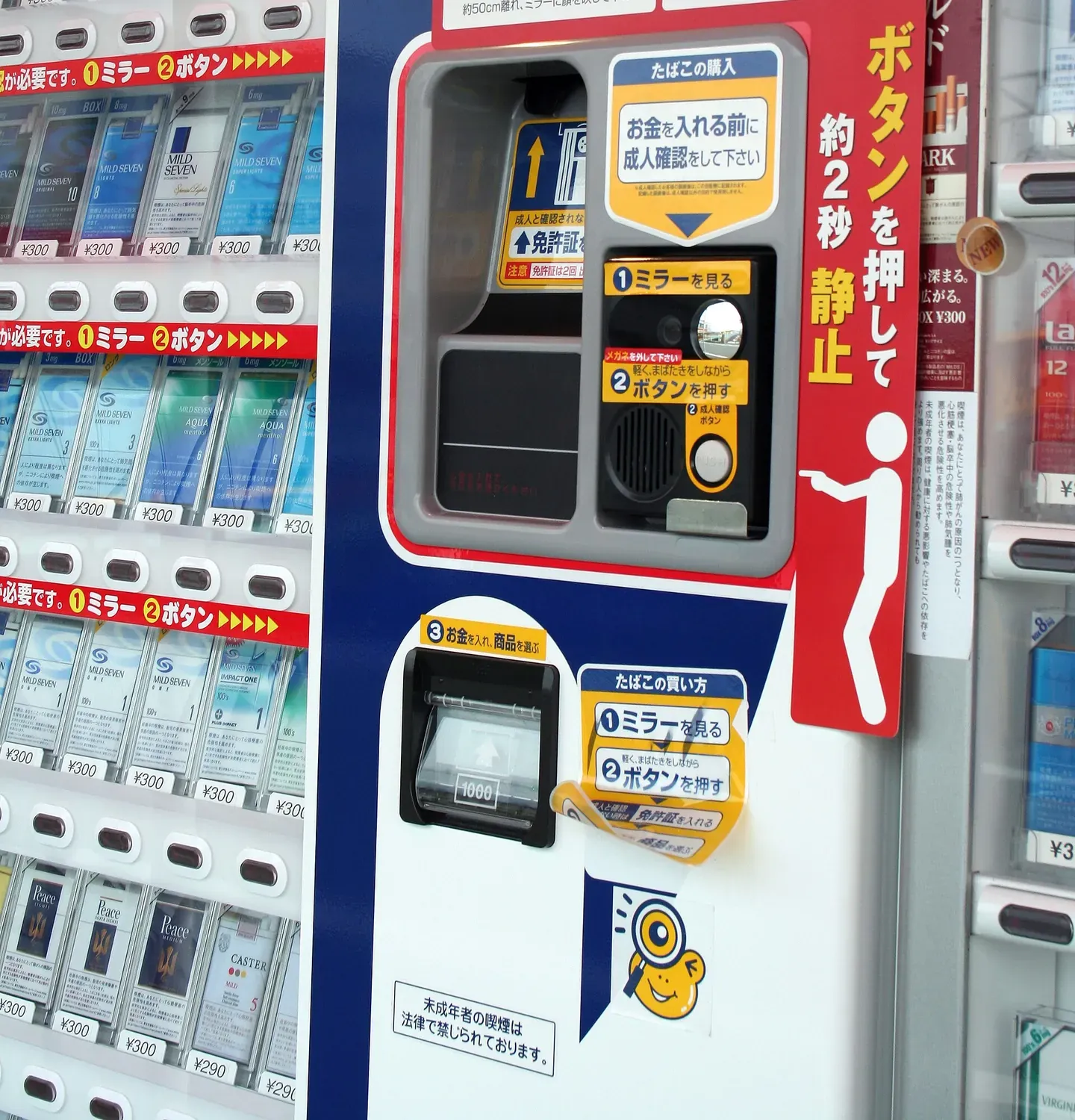
Photo: Corpse Reviver · Wikimedia Commons
CC BY-SA 3.0 Modified
The instructions read "look at the mirror," then "push the button." The camera guessed the buyer's age from that one glance. This unit is a leftover — the method stopped being approved for new machines after 2015.
Where the remaining machines are, and why it barely matters
Cigarette vending machines in Japan have been disappearing for two decades. There were roughly 630,000 of them at the peak; by the end of 2025 that number had fallen to 57,100, a 13.4% drop in a single year.5 Most of what’s still running sits outside small, independently run tobacco shops rather than on busy streets — the kind of shop run by one owner, often older, that hasn’t switched to convenience-store-style retail; KONYA Tobacco House in Kushiro, Hokkaido is one example, with a machine of its own by the entrance. A few also still stand outside a ryokan (a traditional Japanese inn) or an older-style hotel, and outside an izakaya (a Japanese-style bar), aimed at guests who don’t want to walk somewhere at night.
This isn’t much of a loss for a visitor, and you shouldn’t expect to actually buy anything from one of these machines even if you find one. Many still show ads for cigarette packs from the 2010s, because nobody has bothered updating them in over ten years. When a machine does have stock, it’s usually down to a couple of old domestic brands at most — our guide to Japanese cigarette brands covers what those brands actually are — and just as often every row shows “sold out” or is completely empty. These machines are worth seeking out if you’re interested in Japan’s retro street culture, but don’t plan on buying cigarettes from one — even a Japanese resident couldn’t count on it working. A convenience store has a full shelf, a clerk who can point you to something else if your first choice is out, and — unlike a vending machine — an actual working way to pay and walk away with cigarettes.
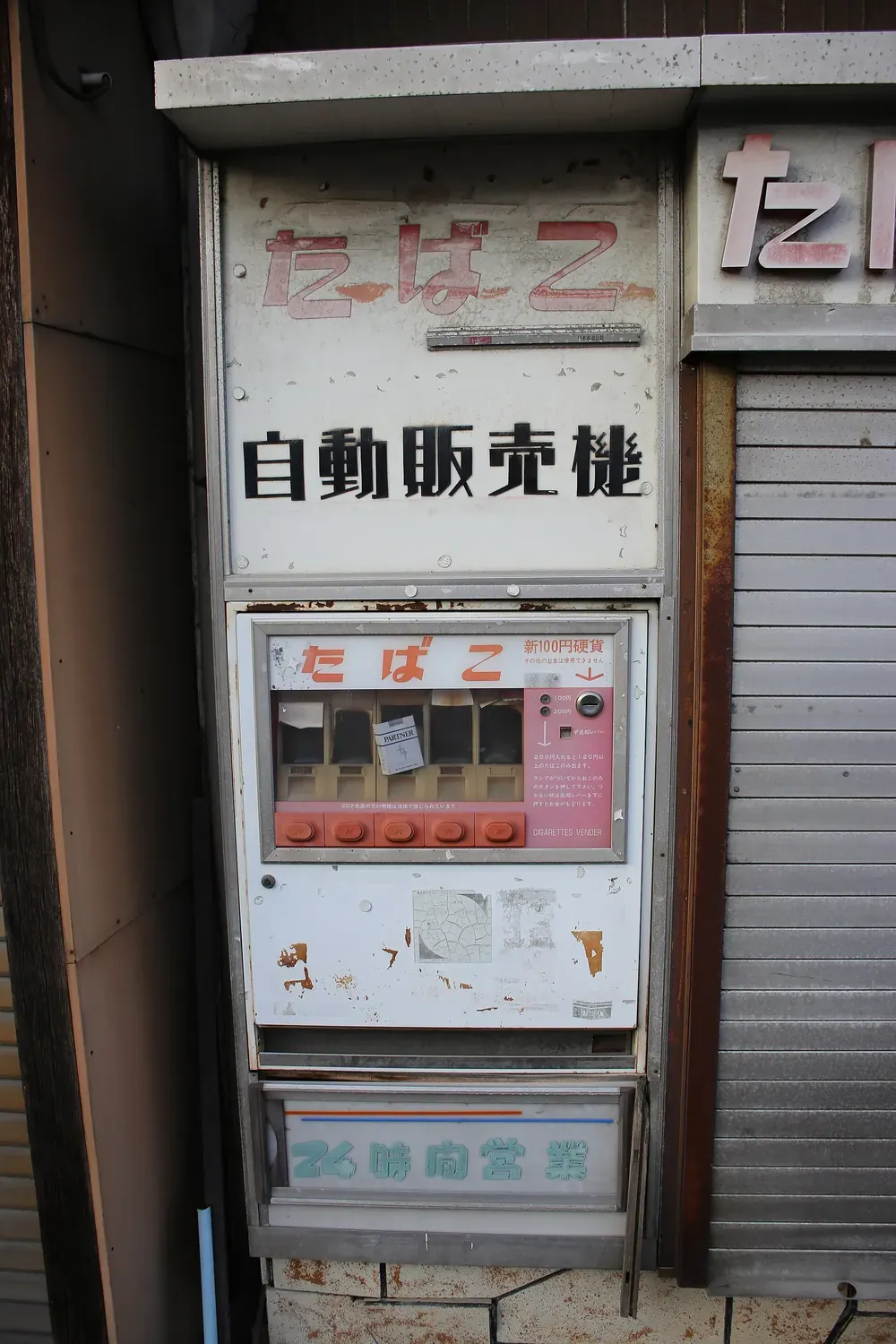
This is the kind of machine still standing today — rusted, faded, and not restocked in years. It might take your coins, but there's no guarantee anything inside is actually for sale.
If you live in Japan
If you’re a foreign resident with a My Number Card, the newer vending machines will work for you the same way they work for a Japanese citizen — insert the card, the machine reads your birth date. A Residence Card (在留カード) is not on the approved list and won’t work in the reader, so don’t expect it to double as ID at a vending machine even though it’s a valid ID almost everywhere else in Japan.
Buy from a convenience store instead
For a tourist, this is the actual answer, not a workaround:
- Pick any 7-Eleven, FamilyMart, or Lawson — cigarettes are behind the counter, not on the shelves.
- Point to the brand and number shown on the numbered display board behind the register, or tell the clerk the number.
- A screen at the register asks the clerk to confirm your age; the clerk taps to confirm you look 20 or older — the legal age to buy tobacco in Japan7 — or asks to see ID if there’s any doubt.
- Pay like any other purchase — cash, card, or IC card such as Suica or Pasmo all work.
For the full walkthrough — brand names, prices, and what to do if the clerk doesn’t understand your order — see our guide to buying cigarettes at a Japanese combini.
Frequently Asked Questions
Can foreigners use cigarette vending machines in Japan?
No. The machines still running read a Japanese driver's license or a My Number Card. Neither is something a tourist has, so the machine will not sell to you.
Can foreigners get a Taspo card?
No. Taspo stopped issuing cards before it shut down entirely, and nobody can get one now, foreign or Japanese.
Does Taspo still exist?
No. Taspo ended on 31 March 2026. Every card is invalid, and the network the cards relied on has been switched off.
Can I buy cigarettes with my passport in Japan?
Not at a vending machine. Japan approved a passport-reading age check in 2024, but machines built for it were never rolled out in any real number. A convenience store clerk checking your passport or asking your age is the normal way tourists buy cigarettes.
How old do you have to be to buy cigarettes in Japan?
20. This did not change when Japan lowered the general age of adulthood to 18 in 2022 — tobacco and alcohol both stayed at 20.
Related Guides
Sources
Show all 7 links
Primary documents and reporting this guide is based on.
- 1 Adult Identification System for Cigarette Vending Machines (Taspo) 成人識別たばこ自動販売機システム(taspo)
Tobacco Institute of Japan
- 2 Taspo Service End Notice taspoのサービス終了について
Taspo (official)
- 3 List of Vending Machines and Age-Verification Devices Recognized as Equipped with an Age-Identification Function, as of 1 April 2026 「年齢識別装置を装備したたばこ自動販売機」に該当すると判定したたばこ自動販売機・年齢識別装置の機種一覧
Ministry of Finance, Japan
- 4 New Age-Verification Device Format: Passport Method, Approved June 2024 新方式の年齢識別自動販売機・年齢識別装置(パスポート方式)
- 5 Cigarette Vending Machine Numbers Fell 13.4% in 2025, as Japan's Vending Machine Market Is Reviewed たばこ自販機は前年比台数13.4%減…自動販売機の現状をさぐる(2026年公開版)
Yahoo! News Japan (data compiled from Japan Vending System Manufacturers Association figures)
- 6 Taspo Service Ends After 18 Years as Face-to-Face Sales Become the Norm たばこ自動販売機のタスポ終了 対面販売主流、18年で幕
Kyodo News, via Sanyo Shimbun
- 7 Act Prohibiting Smoking by Persons Under Twenty Years of Age 二十歳未満ノ者ノ喫煙ノ禁止ニ関スル法律
e-Gov, Government of Japan