Bringing Tobacco, Heated Tobacco and Nicotine Vapes Into Japan: The Customs Limits
Japan's tobacco and heated tobacco allowance, the nicotine e-liquid import limit, and the device rule almost every guide gets wrong — with the official figures and the myths that keep circulating.
Tokyo International Airport International Terminal -05
Photo: Aimaimyi · Wikimedia Commons
CC BY-SA 3.0 Modified
Japan’s tobacco allowance is 200 cigarettes per adult — or 200 heated tobacco sticks, 50 cigars, or 250g of loose tobacco.1 That part is simple.
Vapes are where it gets strange. Nicotine e-liquid is not treated as tobacco in Japan at all. It is legally a medicine, and that single classification explains everything that confuses travellers: why you can bring your own supply in, why you cannot buy a replacement anywhere in the country, and why the limits are written in millilitres and puff counts instead of packs.
Quick answer: every limit in one table
| What you’re bringing | Limit per adult | The catch |
|---|---|---|
| Cigarettes | 200 | — |
| Heated tobacco sticks | 200 (10 packs) | — |
| Cigars | 50 | — |
| Rolling or pipe tobacco | 250g | — |
| Nicotine e-liquid | 120ml | Also capped at 12,000 puffs — see below |
| Nicotine cartridges / pods | 60 | Counted together with liquid, not separately |
| Atomiser (coil) | 1, plus 1 spare | Built-in atomisers count as cartridges instead |
| Zero-nicotine liquid | No limit | Not a medicine, so these rules don’t apply |
Minimum age is 20 for everything on this list.6
Cigarettes, cigars and rolling tobacco
The straightforward part. Per adult:
- 200 cigarettes — one carton of ten packs
- 50 cigars
- 250g of rolling or pipe tobacco
Pick one of those three and you’re done. All of them assume the tobacco is for your own use — commercial quantities are a different process entirely.1
If you’re carrying more than one of them, skip ahead to the 250g rule below, because they don’t simply add together.
Heated tobacco: Japan is one of the easy ones
Unlike much of Asia, Japan lets you bring heated tobacco in without any special hassle — both the sticks and the devices themselves. That’s not the norm regionally: several nearby countries ban the category outright. Japan is also where the category is most developed, with a domestic market full of flavours and variants you won’t find anywhere else. For the full lineup, prices and how IQOS, glo and Ploom compare, see our guide to TEREA, Ploom and IQOS in Japan.
The limit is 200 sticks per adult — the same number as the cigarette allowance, and exactly one carton.1
A couple of details behind that number. Japan Customs writes the allowance as “10 individual packages,” which is ambiguous if you’ve never bought them — it means ten packs, not ten cartons. A pack holds 20 sticks, so ten packs is 200.1 If you use the older capsule-type products instead, the equivalent figure is 50 capsules.
Before you buy a carton to take home, check where you’re flying next. In several countries heated tobacco isn’t just limited — it’s banned. That’s a different thing entirely: banned means confiscated at the border regardless of quantity, and there’s no duty you can pay to make it legal.
Hong Kong and Singapore prohibit it completely. Australia blocks it unless you have an import permit, which you won’t as a tourist. Our guide to duty-free tobacco allowances by country covers which countries ban it outright and which simply count it separately from cigarettes.
Mixing tobacco types: how the 250g rule actually works
If you bring only one kind of tobacco (say, just cigarettes, or just rolling tobacco), use the number in the table above and skip this section. The rule that trips people up is the combination one: bring more than one type and the total must stay within 250g equivalent.1
Here’s the part we have to be upfront about: Japan Customs does not publish a conversion formula for this. We looked hard, and there is no official table anywhere that says how many cigarettes equal how many grams, or how a heated-tobacco stick converts against loose tobacco. The only official worked example we could find covers one specific case — a traveller bringing 200 cigarettes and 50 heated-tobacco capsules at once, where customs exempted whichever category would have cost more in tax (the 200 cigarettes) and charged the flat rate on the other (50 × ¥50 = ¥2,500).7 That shows the general principle — customs favours the traveller when deciding what to tax — but it’s one demonstrated pairing, not a formula you can safely apply to a different combination of your own.
This isn’t a guess based on our own experience — it’s the absence of anything official to point to. Until that changes, treat any specific mixed-category maths — including anything you read elsewhere, this page included — as an estimate, not a guarantee.
Given that, here’s what we’d actually do:
- Simplest and safest: bring only one category. One carton of cigarettes, or 200 heated tobacco sticks, or 250g of rolling tobacco — nothing else. There’s no conversion question to answer, and these are the exact scenarios official guidance covers directly.
- If you’re mixing, leave yourself real margin rather than testing the ceiling. Something like 100 cigarettes (five packs) plus a 50g pouch of rolling tobacco works well as a template: that’s half of one allowance and a fifth of the other, so even under a stricter reading than you expected, you’re nowhere near the edge. Compare that with 100 cigarettes plus 100g of rolling tobacco, which lands at 90% of the combined limit — technically fine on our reading, but with almost nothing to absorb a different interpretation.
- If your situation is unusual in any way, talk to an officer instead of guessing. More than 200 cigarettes, an odd mix of categories, three coils instead of two, anything that doesn’t match a scenario on this page — that’s what the red channel is for.
And on that last point, be clear about what you’re actually choosing between. Declaring costs you ten minutes and, at worst, some duty — the officer runs the calculation for you, tells you the figure, and you pay at a counter. Walking through the green channel with undeclared excess is a completely different situation: at that point it stops being a duty question and becomes an enforcement one, with seizure and penalties on the table. The downside of asking is trivial. The downside of not asking, when you should have, isn’t.
Customs Info sign multilingual in New Chitose Airport
Photo: Ominae · Wikimedia Commons
CC BY-SA 4.0 Modified
A multilingual customs information sign at a Japanese international airport, written in Japanese, Chinese, Korean and Russian.
Going over the limit: what it actually costs
Going over is not an offence. It is a paid option, and Japan publishes a flat simplified rate for exactly this situation:1
| Product | Rate over the allowance |
|---|---|
| Cigarettes | ¥15 each |
| Heated tobacco sticks | ¥15 each |
| Capsule-type | ¥50 each |
Three worked examples, so you can do the maths before you buy rather than at the counter.
Two cartons of cigarettes. Bring 400 cigarettes — double the allowance — and you owe duty on the 200 over: 200 × ¥15 = ¥3,000. Two cartons at duty-free cost 2 × ¥4,450 = ¥8,900, so the total lands at ¥11,900 for 400 cigarettes.
One HTP carton plus one cigarette carton. This one looks like it should be simple — 200 sticks and 200 cigarettes, one carton each — but it’s actually the cleanest illustration of the gap we flagged earlier: bringing two full allowances together triggers the mixed-category rule, and here the two sides are an exact tie. Taxing 200 cigarettes costs 200 × ¥15 = ¥3,000. Taxing 200 sticks costs the same, ¥3,000. The “exempt whichever costs more” principle from the official capsules example doesn’t tell you which one wins when both cost identically — because it was never designed to. Either way, you’re paying duty on one full carton’s worth, ¥3,000, on top of what the two cartons cost you. If you’re planning exactly this combination, this is a good one to just declare and let the officer decide rather than assume either outcome.
Buying at duty-free right after you land — is it worth it? Some arrival duty-free shops let you buy a carton the moment you’re through passport control, before you’ve even collected your bags.
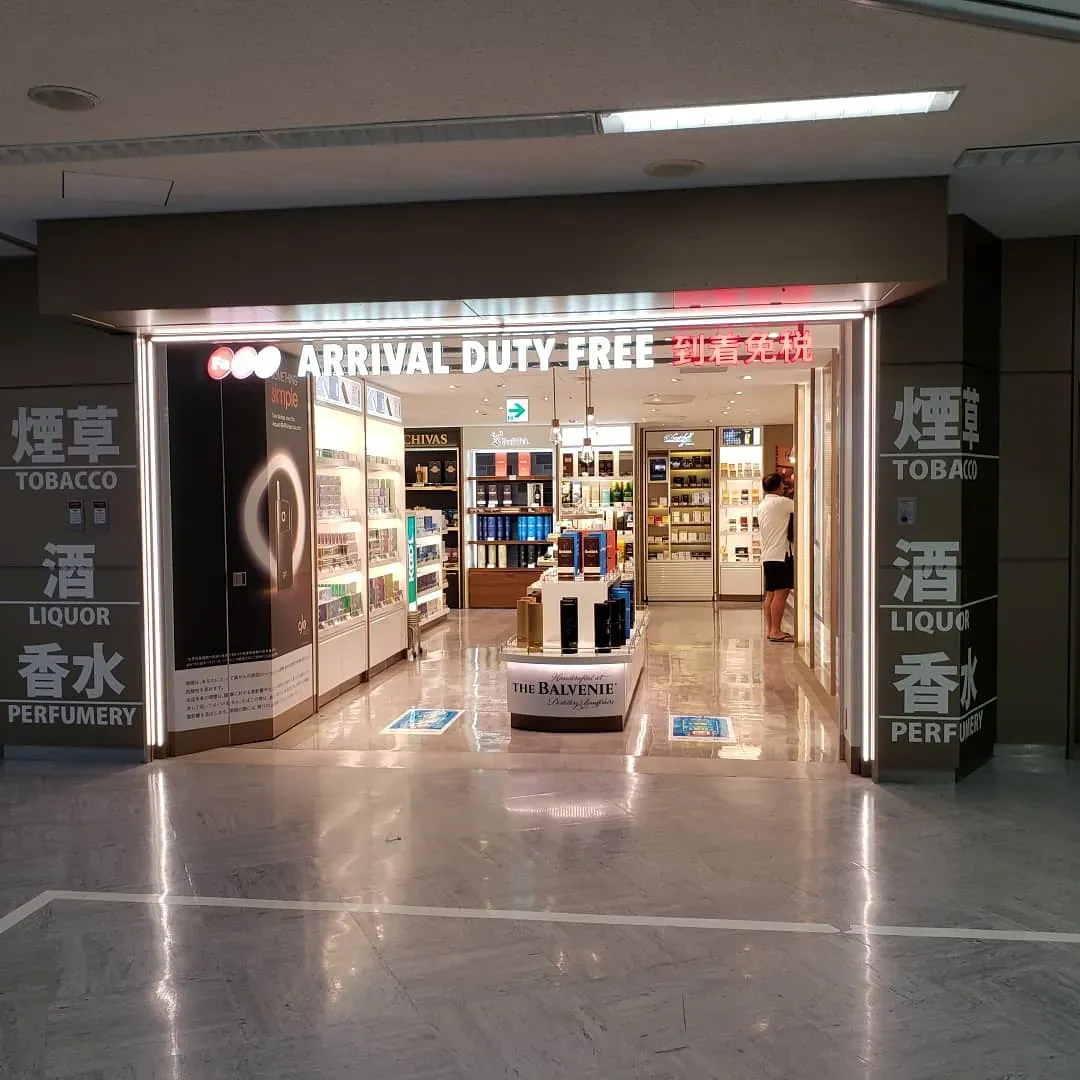
The arrival duty-free shop at Narita Airport. It's marked 到着免税, with signs for tobacco, liquor and perfumery.
One carton is the easy win. 200 cigarettes is exactly Japan’s own allowance, so there’s no duty at all. A carton costs ¥4,450 at duty-free against ¥6,200 for the same 200 cigarettes at a Japanese convenience store — you save ¥1,750, and you can just smoke them for the rest of your trip. Simple, no maths required.
Three cartons is where it gets complicated. That’s 600 cigarettes against a 200-cigarette allowance — 400 over, taxed at ¥15 each, so ¥6,000 in duty. Three cartons at the plain price (3 × ¥4,450 = ¥13,350) plus that duty comes to ¥19,350 — more than the ¥18,600 it’d cost to just buy 30 packs at a combini. Without a discount, three cartons at arrival duty-free is actually a bad deal.
The only way three cartons wins is with a bulk discount. Departure shops document one — ANA Duty Free takes 12% off three or more Marlboro cartons, down to ¥3,916 each. If your arrival shop offers the same (we couldn’t confirm it does — worth just asking), the total drops to ¥11,748 + ¥6,000 duty = ¥17,748, which beats the combini price by about ¥850. Whether three cartons is worth it comes down entirely to whether that discount is on offer where you land.
Don’t stress too much about this either way — Japanese cigarette prices aren’t high to begin with. You’re looking at roughly $3–4 a pack even at full city price, so the gap between “great deal” and “no deal” here is a few hundred yen, not a lot of money. If duty-free prices are what you’re actually after, our guide to duty-free cigarette prices in Japan has the full breakdown by brand.
How you actually pay: declare through Visit Japan Web before you land, or fill in the paper form, then take the red channel. The calculation happens at a staffed counter, and payment happens at a separate counter next to it — cash in yen works everywhere, and credit card is accepted at Japan’s major international airports for exactly this kind of payment.8
Not declaring is the part that carries real risk — that’s where seizure and penalties come in, not from the duty itself.
Vapes: limit on devices, pulls and on liquid
Vapes aren’t treated as tobacco in Japan — they’re treated like medicine you’re bringing in for yourself. That’s the only reason to know; the limits below are what actually matters.
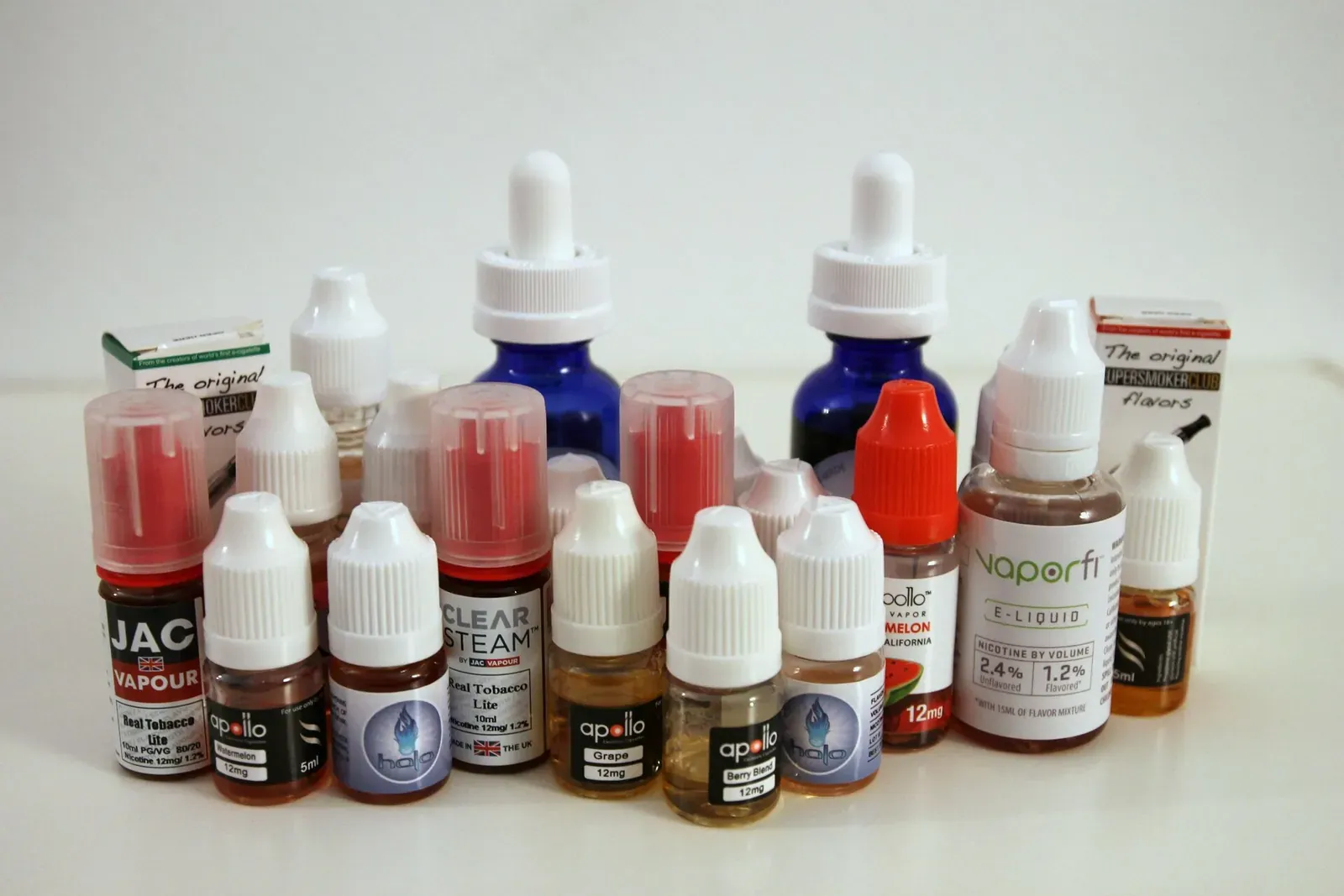
Bottles of nicotine e-liquid, labelled with strength in milligrams and volume in millilitres. Japan's 120ml import limit is measured in these same units.
| What you’re carrying | Your limit |
|---|---|
| Bottles of e-liquid | 120ml total |
| Disposables | 12,000 puffs total (count puffs, not ml) |
| Refill pods or cartridges | 60 total |
| Coils (removable ones) | 1 in the device, plus 1 spare |
| Liquid and cartridges mixed together | Add them up — no separate allowance for each3 |
Quick check: does your setup work?
✅ Fine:
- One vape, one coil in it, one spare coil, 120ml of liquid.
- One disposable at 12,000 puffs.
- One vape (2 coils total) + 70ml of liquid + two disposables at 2,500 puffs each.
- Six disposables at 2,000 puffs each (12,000 total).
- 50 small refill pods, whatever the size — cartridges are counted by number, not volume.
❌ Not fine:
- One vape + 200ml of liquid — liquid alone is 80ml over.
- Three vapes, each with its own coil — three coils is one too many.
- Two disposables at 12,000 puffs each — 24,000 combined, double the cap.
The coil rule, simply
The rule: one coil in your vape, plus one spare. That’s the limit, full stop.
A few things worth knowing on top of that:
- This is for removable coils only. Disposables and sealed pods don’t have a coil you can take out, so they’re counted as cartridges instead (limit: 60) — not against this rule at all.
- You’ll see “two vape devices” as the rule online. That’s close but not quite right — it’s about coils, not devices. Two coils spread across two vapes is fine. Three separate vapes, each with its own coil, is one coil too many, even though it’s “only” three devices.
- There’s a real possibility this limit doesn’t apply at all if you’re carrying zero nicotine. The rule exists because the device is classed as equipment for handling nicotine. No nicotine in your bag at all — no liquid, no cartridges — and the legal basis for the “1 + 1” limit arguably isn’t there. We think this reading is genuinely correct, but we haven’t found an official confirmation or anyone’s real travel experience to back it up. If you’re carrying only nicotine-free gear, this is worth knowing about — but if you want zero risk, just stick to “1 + 1” anyway, or ask an officer on arrival rather than assuming.
- Coils themselves aren’t controlled — buy replacements at any vape shop in Japan, no prescription needed. More in our guide to vaping culture in Japan.
Puffs matter more than millilitres
Disposables are rated in puffs, and puff counts have climbed a lot. A device advertising 20,000 puffs holds very little liquid — but it’s still 20,000 against a 12,000 cap, on its own:
| What you’re bringing | Puffs | Against the 12,000 limit |
|---|---|---|
| Two 5,000-puff disposables | 10,000 | Fine |
| One 20,000-puff disposable | 20,000 | Over, by itself |
| One 46,000-puff disposable | 46,000 | Nearly 4x over |
Check the puff number on the box, not the liquid volume.
Mixing bottled liquid with disposables? There’s no official formula for combining ml and puffs. Our working rule of thumb: 1ml ≈ 100 puffs, based on how the headline figures line up (120ml and 12,000 puffs describe the same “one month” allowance). So if you’re carrying a 10,000-puff disposable and 20ml of liquid, that’s 10,000 + (20 × 100) = 12,000 — right at the cap, and should clear. If each part is comfortably under its own limit on its own, you’re fine regardless of which method you use. If it’s close, declare it rather than guess.
One more thing, and it applies to everything on this page: numerically clearing a limit isn’t the same as looking reasonable. Forty tiny 300-puff disposables adds up to exactly 12,000 puffs and exactly 40 cartridges — technically inside both caps. But forty separate devices in one suitcase doesn’t read as “personal use” the way six does, and “we don’t know” what an officer does with that once it stops looking like a vaper’s travel kit and starts looking like a bag of retail stock. Same caps, same rules, but bring what you’d actually get through, not the maximum the arithmetic allows.
Over any of these limits? You need paperwork from Japan’s Health Ministry arranged before you fly — this is rarely granted, so treat the numbers above as hard limits. Bring too much without it, and the excess just gets confiscated; it isn’t treated as smuggling.3
These figures have been stable for years, and were still current as of July 2025.4
Zero-nicotine liquid isn’t a medicine, so none of this applies to it.
Vapes: you can’t buy nicotine liquid in Japan
This is the single most important thing to plan around, and it surprises almost everyone.
No shop in Japan can legally sell nicotine e-liquid — not a vape shop, not a pharmacy, not a convenience store. The reason is the same medicine classification: a medicine needs regulatory approval to be sold, and no nicotine e-liquid has ever received it.5
So if you run out mid-trip, you cannot restock. Your options become zero-nicotine liquid, which is sold freely at vape shops, Don Quijote and some convenience stores, or switching to heated tobacco or cigarettes, which are available everywhere.
Bring what you need for the whole trip. For what the domestic scene actually looks like — shops, brands, the zero-nicotine market — see our guide to vaping culture in Japan.
Three myths about bringing tobacco into Japan
“Visitors can bring 400 cigarettes.” You’ll still see this on older travel articles floating around online. It hasn’t been true for years. The limits are now identical for residents and visitors alike — they’re the ones listed at the top of this guide. Don’t get the two mixed up.29
“Japan banned disposable vapes in April 2025.” This appears on several English-language vape sites and is not supported by any Japanese government source. Zero-nicotine disposables remain openly on sale in Japan, and Japanese retailers were still launching and reviewing new high-puff models through 2026. The claim looks like confusion with the United Kingdom’s own disposable vape ban, which did take effect in 2025.
“You need a prescription to import nicotine liquid.” No. Within the personal allowance it clears on the customs officer’s check alone, with no prescription and no permit.3 Paperwork only enters the picture above a month’s supply.
Taking tobacco home from Japan
Everything above is about getting into Japan. Going the other way is a completely separate set of rules, set by wherever you land — and the numbers vary far more than most people expect, from 200 cigarettes down to 25 in Australia and none at all in Singapore.
For the country-by-country table, the duty rates and what happens when you go over, see our guide to duty-free tobacco allowances by country.
Frequently Asked Questions
How much tobacco can I bring into Japan?
Per adult: 200 cigarettes, or 200 heated tobacco sticks, or 50 cigars, or 250g of other tobacco. If you bring more than one type, the combined total must stay within 250g equivalent. There is no allowance at all under the age of 20.
What does '10 individual packages' of heated tobacco mean?
Packs, not cartons. A pack of IQOS or glo sticks holds 20, so 10 packages comes to 200 sticks — the same number as the cigarette allowance. It is one carton, not ten.
Can I bring my vape to Japan?
Yes. Nicotine e-liquid is legal to bring for personal use — the limit is 120ml of liquid or 60 cartridges. The device itself is treated separately as a medical device, with a limit of one plus one spare.
Can I buy nicotine e-liquid in Japan?
No. Nicotine e-liquid is classed as a medicine and no product has ever been approved for sale, so no shop in Japan can legally sell it. Zero-nicotine liquid is sold freely. Bring what you need for the trip.
How many disposable vapes can I bring into Japan?
It depends on the puff count, not just the volume. The allowance is also capped at 12,000 puffs, so a single 20,000-puff disposable already exceeds it even though its liquid volume is well under 120ml.
Is it true that Japan banned disposable vapes?
No. This claim circulates on English-language vape sites but no Japanese government source announces such a ban, and zero-nicotine disposables are openly sold in Japan. It appears to be confusion with the UK's own disposable ban.
Do I need a prescription or permit to bring nicotine e-liquid?
Not within the personal limit. Up to 120ml of liquid or 60 cartridges clears on the customs officer's check alone. Only above that do you need an import certificate from the Health Ministry.
Is it true that visitors can bring 400 cigarettes into Japan?
No. That figure still turns up on older travel articles but hasn't been accurate for years. The current allowance is 200 cigarettes, and it's the same for residents and visitors alike.
Does duty-free tobacco bought on arrival count against the allowance?
Yes. Narita, Haneda and Kansai all have arrival duty-free shops, and what you buy there is an import like any other — it counts against the same 200-cigarette allowance.
Related Guides
Sources
Show all 9 links
Primary documents and reporting this guide is based on.
- 1 Japan Customs Table of Duty-Free Allowances for Arriving Travellers, With Heated Tobacco Figures and the Rates Charged on Excess Procedures of Passenger Clearance
Japan Customs, Ministry of Finance
- 2 Japan Customs' Own Announcement Comparing the Old 400-Cigarette Allowance to the New 200-Cigarette Allowance, Effective 1 October 2021 Exemptions of Tobacco to be Changed
- 3 Japan's Health Ministry Q&A Setting the Personal Import Limits for Nicotine E-Liquid, Cartridges and Atomising Devices 医薬品等輸入手続質疑応答集(Q&A)について(Q63)
Ministry of Health, Labour and Welfare, Japan
- 4 Japanese Pharmaceutical Industry Federation Circular Confirming the E-Cigarette Import Figures Remain Current, July 2025 医薬品等輸入手続質疑応答集(Q&A)について(日薬連発第456号)
Federation of Pharmaceutical Manufacturers' Associations of Japan
- 5 Japan's Trade Promotion Body Explaining Why No Nicotine E-Liquid Has Ever Been Approved for Sale in Japan 電子タバコ、電子タバコリキッドを輸入・ネット販売
MIPRO (Manufactured Imports and Investment Promotion Organization)
- 6 Japan's Ministry of Finance Confirming the Tobacco Purchase Age Is 20 二十歳未満の者の喫煙防止ポスターの掲載について
Ministry of Finance, Japan
- 7 Japan Customs' Own Worked Example Showing How Mixed Tobacco Types Are Assessed — Exempting Whichever Category Costs More to Tax 税額の計算方法
- 8 Japan Customs' Official Q&A Confirming Credit Card Payment for Duty at Major Airports クレジットカードを利用した関税等の納付に関するQ&A
- 9 Japan Customs' Allowance Page, Confirming the Current Limits Apply Equally to Residents and Non-Residents 海外旅行者の免税範囲