Duty-Free Tobacco Allowances by Country: How Much You Can Bring Home
Duty-free tobacco allowances for nine countries, what happens when you go over, and the duty rates with worked examples for each.
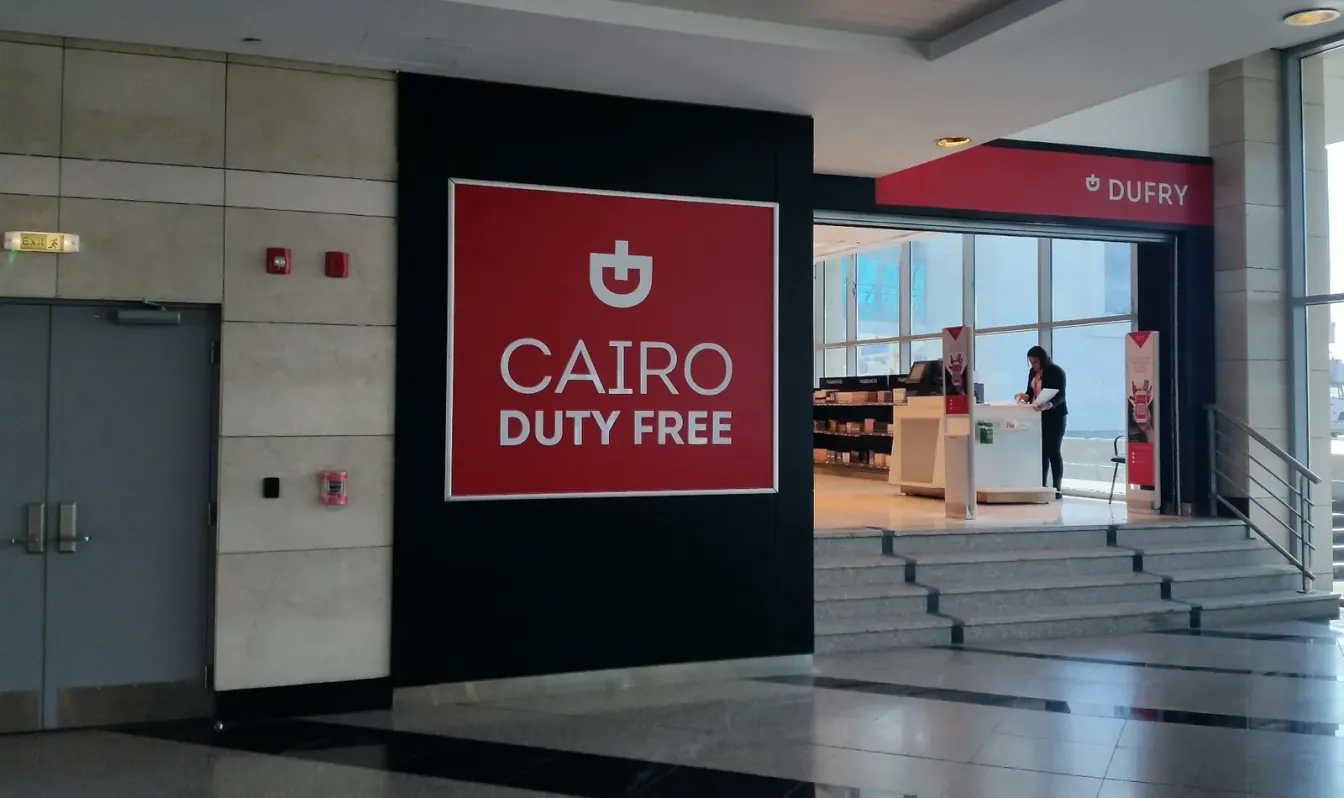
Japan puts no limit on how much tobacco you buy before you fly. The limit comes from the country you land in, and the numbers are further apart than most people expect: one carton from Narita is exactly the allowance for the United States, the United Kingdom, Canada, Ireland and South Africa — four times New Zealand’s limit, eight times Australia’s, and infinitely more than Singapore’s, which gives no duty-free allowance for tobacco at all.
The rules are simply different everywhere, in three separate ways. Some countries let you spread a purchase across your whole travel group — three adults means three separate allowances, not one shared pot. Some charge you only for what’s over the limit when you exceed it, others charge you for everything you’re carrying the moment you go one cigarette over. And the tax itself ranges from almost nothing to genuinely brutal — Australia’s rate alone can cost you more than the cigarettes did.
Quick answer, if that’s all you need: a standard carton from Japan is 200 cigarettes.
| Destination | Where a carton lands you | The short version |
|---|---|---|
| US, UK, Canada, Ireland, South Africa | Exactly the limit | Bring it, no issue |
| New Zealand | 4× the limit | Fine — pay duty on the extra 150, or just bring less |
| Hong Kong | About 10× the limit | Technically fine, but almost the whole carton is “excess” |
| Australia | 8× the limit | Not worth it — the duty alone costs more than the carton did |
| Singapore | No duty-free allowance exists | Don’t buy tobacco in Japan for this trip |
The rest of this guide is for the details behind that table — the per-person rule, what “excess” actually costs in each country, and the traps specific to Canada and heated tobacco.
Looking for Japan’s own import rules instead? This guide is about what you can carry home once you land somewhere else — the allowance and duty rates set by the country you’re flying to. If you’re actually asking how much tobacco or vape liquid you can bring into Japan, that’s a completely different set of rules (Japan’s own allowance, the nicotine e-liquid limits, and the “two vapes” myth), and it lives on its own page: our guide to bringing tobacco and vapes into Japan.
Allowances by destination
Cigarette counts, per adult traveller. Rules for loose tobacco and cigars differ.
| Destination | Cigarettes | Minimum age | If you go over |
|---|---|---|---|
| United States | 200, once every 30 days12 | 211 | Duty on the excess only |
| United Kingdom | 200 or 200 heated tobacco sticks or 250g — one category only3 | 17 | Duty on the whole category |
| Canada | 200, plus 200 tobacco sticks, after 48 hours abroad9 | 189 | Duty on the excess, plus a stamp rule explained below |
| Australia | 25, plus one open packet6 | 18 | Duty on all your tobacco |
| New Zealand | 508 | 178 | Duty on the excess only |
| Ireland | 200, arriving from outside the EU12 | 1713 | Duty on goods in excess of the allowance12 |
| Singapore | No duty-free allowance — every cigarette is taxable14 | 21 | Declare and pay on all of it |
| South Africa | 20018 | 1818 | Duty on the excess only19 |
| Hong Kong | 19 — one fewer than a full pack, on purpose22 | 1822 | Declare and pay duty |
The allowance is per person, not per family
Each adult carries their own allowance. Three adults flying to the United States may bring 200 cigarettes each — 600 in total, three cartons from Narita. Two adults flying to New Zealand may bring 50 each. Two adults flying to Australia may bring 25 each, which is two and a half packs between them.
Three things break that arithmetic.
Children add nothing. No country in this guide gives a tobacco allowance below its minimum age. A family of two adults and two children flying to the US has 2 × 200 = 400 cigarettes, not 800.
Each person carries their own. The allowance follows the traveller, not the suitcase. The UK states this directly: you cannot combine your personal allowance with anyone else’s.3 Ireland says the same — allowances cannot be shared with other people travelling in your group.13 South Africa’s guidance repeats it. Hong Kong’s own wording, “for his own use,” works the same way — it’s an individual entitlement, not a household one.22
To be clear about what this actually means in practice, because “cannot combine” is easy to misread: it does not mean the group total stays capped at one person’s allowance. It means each person’s allowance stays theirs and doesn’t top up anyone else’s. Two adults arriving in Hong Kong carry 19 + 19 = 38 cigarettes between them — same multiplication as everywhere else in this guide — but neither of them can personally carry all 38 while the other carries none. So two adults have 200 each in the US, not one shared 200. One of them cannot legally carry 400 for the pair, because that person is over their own limit. Split the cartons across your bags.
Don’t confuse tobacco with the general goods limit. Countries also set a value limit on ordinary purchases — $800 in the US, £390 in the UK, and so on — and some of them do let families group that figure. Tobacco does not work that way anywhere in this guide. Cigarettes are not pooled, and the per-adult count stands whatever the family arrangement.
Australia is the one place worth checking yourself. Australian Border Force does let families travelling together on the same flight pool their duty-free concessions if they clear customs as a group, but its published examples cover the general goods limit rather than tobacco.6 Under-18s get no tobacco concession either way.
What if you go over the duty-free limit?
Countries handle the excess in two opposite ways, and mixing them up is expensive.
Rule A — you pay for the extra only
US · Canada · New Zealand · Ireland · South Africa
The United States, Canada, New Zealand, Ireland and South Africa.
New Zealand’s allowance is 50 cigarettes. You arrive with a carton of 200. Then 200 − 50 = 150, and duty is charged on 150 cigarettes. The first 50 stay free — New Zealand Customs says so explicitly, and also offers a disposal bin if you would rather abandon the excess than pay for it.8 Ireland words it the same way: charges apply to goods in excess of the duty-free allowances.12 South Africa’s internal guidance for its own officers spells out that excess consumables are assessed on the quantity over the allowance, not the whole amount.19
Rule B — you pay for all of it
UK · Australia
The United Kingdom and Australia. Go one cigarette over and the allowance disappears completely.
Here is what that costs in the UK. You buy two cartons at Narita for ¥8,900, roughly £41 at July 2026 exchange rates. The UK allowance is 200 cigarettes, so you are 200 over.
- What most people expect: duty on the extra 200.
- What actually happens: duty on all 400.3
HMRC doesn’t just apply the normal cigarette tax rate here — there’s a separate, simplified flat rate for exactly this situation, and it tracks the same floor rate that ordinary cigarette duty sits at. Right now that works out to £471.93 per 1,000 cigarettes.45
Do the maths on the two cartons: 400 × £0.47193 ≈ £189 in duty, plus 20% import VAT on top of the value and the duty, which adds roughly £46. Call it £235 total — on cigarettes that cost you about £41 at the airport.
Treat that number as a ballpark, not a quote. The rate moves with every Budget, and HMRC’s own online declaration service at gov.uk/duty-free-goods will show you the actual figure on the day. What stays true regardless: the second carton doesn’t just cost its own duty — it drags the first carton’s duty along with it, the one that would otherwise have been free. For the UK, one carton is the ceiling, full stop.
Australia is sharper still. The allowance is 25 cigarettes, so a single carton puts you 175 over — and duty applies to all 200. The Australian Taxation Office’s current published rate is A$1.52829 per cigarette, for the period running to 31 August 2026.7 So 200 × A$1.52829 ≈ A$306 in customs duty alone, before GST, on a carton that cost about A$39. For Australia, the airport carton is not worth buying.
Rule C — no duty-free allowance at all
Singapore
Singapore gives no duty-free concession for tobacco. Every cigarette is dutiable from the first one.14 The Ministry of Finance raised the rate by 20% in Budget 2026, and Singapore Customs sets it at S$0.589 for each gram, or part of a gram, of every stick — which comes to about S$0.589 for a standard cigarette.1516 That is 200 × S$0.589 ≈ S$118 per carton, before 9% GST.
There is a second problem for Singapore specifically. Japanese packs do not meet Singapore’s standardised packaging requirements, and packs that do not comply are not allowed in at all — they are disposed of at the checkpoint.14 Paying the duty does not fix that. For Singapore, do not buy tobacco in Japan.
Hong Kong belongs in this group too, in spirit if not in mechanism. Its allowance is technically not zero, but at 19 cigarettes it might as well be — deliberately set one below a full pack, so it never actually covers a duty-free purchase. A carton from Narita is 200 cigarettes; 181 of them arrive over the limit no matter how you look at it. That doesn’t necessarily mean it’s a bad deal, though — see the worked example below.
Is it worth it? Two real comparisons
All the duty math above answers “how much will this cost me.” It doesn’t answer the question that actually matters: is a Narita carton still cheaper than buying at home once you add the duty? Here are two real answers, one easy and one that surprised us.
The US: no duty at all, straightforward saving. 200 cigarettes is exactly the US allowance, so there’s nothing to calculate beyond the price gap itself. A Narita carton at ¥4,450 is about $27 at July 2026 exchange rates. Pack prices in the US vary a lot by state — driven mainly by state cigarette taxes, which range from $0.17 to $5.35 a pack, a 31x spread27 — and different price trackers disagree with each other by close to double for the same state, so a specific state figure isn’t something we’d stand behind here. One figure that is solid: New York State publishes legally enforced minimum retail prices for standard-brand cigarettes sold in New York City, one of the country’s highest-taxed markets — currently about $14 to $22 a pack, or $142 to $215 a carton.26 Even at the low end of that range, a Narita carton saves you roughly $115 — and towards the high end, the saving climbs past $180. Flying with others? Split extra cartons across your travel companions’ bags rather than one person carrying several — each adult has their own 200-cigarette allowance, but it’s a personal allowance, not a shared one, so one person turning up with 600 cigarettes is 400 over their own limit even if the group total would have been fine.
Hong Kong: still worth it, even after a real duty bill. This is the one that looks bad on paper and isn’t. Bring a single Narita carton (200 cigarettes) into Hong Kong, and 181 of them are over the 19-cigarette allowance. At the official duty rate of HK$3.306 per cigarette, that’s HK$598 in duty on top of the roughly HK$212 the carton cost you — a landed cost of about HK$810.23 That sounds steep until you check the local price: after two consecutive duty hikes in 2023 and 2024-25, the government’s own figures put an average pack at about HK$94 — roughly HK$940 for a carton.2425 So the “expensive” option still saves you about HK$130, or 14% — the duty is real, but Hong Kong’s own retail price has climbed even faster.
The gap holds up at volume, too. Buy three cartons at Narita using ANA’s 12%-off multi-carton discount (¥3,916 a carton instead of ¥4,450), and you’re bringing in 600 cigarettes against the same 19-cigarette allowance — 581 over, taxed at HK$3.306 each, for about HK$1,921 in duty. Add that to the discounted carton price and the landed cost comes to roughly HK$2,480 for 600 cigarettes, against about HK$2,820 at the local average price — a saving of HK$340, or about US$44.232425
One caution that applies to both examples, and especially Hong Kong. Unlike Canada’s explicit five-carton ceiling, Hong Kong doesn’t publish a hard numeric cap on how much you can bring in and simply pay duty on. The actual line is “personal use” versus “commercial purposes” — undefined in cigarette counts, and it’s a judgment call the officer in front of you gets to make.22 Three cartons for personal use over a trip is a reasonable, common request. Showing up with ten or twenty is a different conversation, and could get your goods treated as an undeclared commercial import rather than an oversized personal one — a meaningfully worse outcome than just paying extra duty. Keep it to what you’d plausibly smoke yourself, not a resale quantity.
The Canadian excise stamp trap
Canada deserves its own section, because the rule catches people who are comfortably inside their allowance.
Canadian duty-free treatment requires the pack to carry the excise stamp “duty paid Canada droit acquitté.” Japanese duty-free packs don’t have it — so even a single carton inside your 200-cigarette allowance gets hit with a special duty on top.9
That rate is C$0.1946 per cigarette, adjusted every April.10 So 200 × C$0.1946 ≈ C$39 per carton. A Narita carton at ¥4,450 is roughly C$38, so C$38 + C$39 ≈ C$77 for 200 cigarettes — still usually cheaper than buying a carton in Canada, but nowhere near the sticker price at the airport.
One carton stays inside your personal exemption, so C$77 is the whole story for it. Bring a second carton and the maths changes completely — not just doubles. CBSA is explicit about this: anything over your 200-cigarette exemption is treated as a regular import, meaning full federal excise duty, GST, and whatever your home province charges, not the flat C$0.1946 special-duty rate.9 That second, “extra” carton is taxed far harder than the first.
Here’s what that looks like with real numbers, using Ontario as the example (it varies by province, but this gives you the shape of it):
| Rate | On 200 cigarettes | |
|---|---|---|
| First carton — special duty (unstamped, within exemption) | C$0.1946/cigarette10 | ≈C$39 |
| Second carton — federal excise duty (excess, “regular” import) | C$0.1946/cigarette10 | ≈C$39 |
| Second carton — GST (5%) | on value + duty | ≈C$4 |
| Second carton — Ontario provincial tobacco tax | 18.475¢/cigarette11 | ≈C$37 |
| Total for two cartons (400 cigarettes) | ≈C$119 |
So two cartons doesn’t cost roughly double the C$77 — it costs closer to C$119, because the second one picks up provincial tax and GST that the first one, inside your personal exemption, never touches. In a higher-tax province like British Columbia, the gap is even wider.
There’s also a hard cap on top of all this: without the stamp, you can bring in at most five cartons total, whatever you’re willing to pay in duty.9
Canada has a few more nuances than that — separate limits if you’re also carrying vape liquid, exactly what counts as a “unit,” how it’s split between tobacco and vaping products. Most travellers with a carton or two of cigarettes will never run into any of it. If you’re bringing more than that, or mixing tobacco with vape products, check the source directly before you fly.9
Heated tobacco is a different question entirely
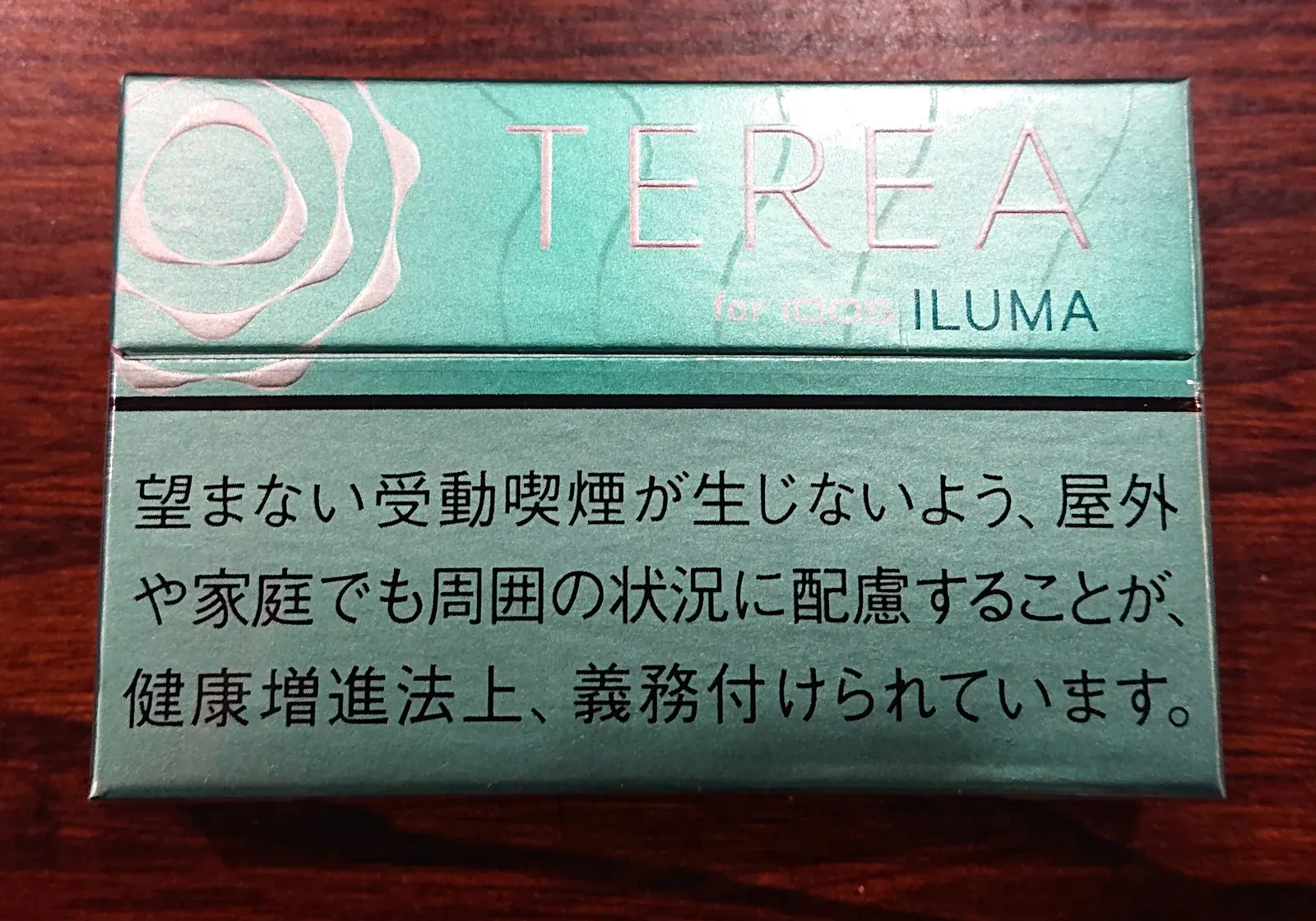
TEREA sticks are what IQOS ILUMA devices burn instead of cigarettes. This is the product the rules in this section actually apply to, in most of the countries below.
For cigarettes, going over the limit is a paid option. For heated tobacco, several countries do not have a limit to exceed — they have a prohibition. The product is seized whatever the quantity, and no amount of duty makes it legal.
- Hong Kong. Import, sale and possession of alternative smoking products, heated tobacco included, are illegal — even a single stick for personal use.28
- Singapore. Banned since 2018. The law names heated tobacco products such as IQOS directly, and covers import, possession and use.29
- Australia. Import is blocked without prior written permission, which an ordinary traveller will not have.30
The list is longer than these three, and it moves. Thailand is widely reported to treat IQOS, glo and Ploom under the same prohibition as e-cigarettes, with confiscation at the border; Macau and several other jurisdictions have their own restrictions. Rules on heated tobacco change faster than rules on ordinary cigarettes, because many countries are still deciding how to classify the category. Check your own country’s customs authority before you fly rather than relying on any list, including this one.
Where heated tobacco is legal, it usually gets counted separately from cigarettes rather than folded into the same number. The UK is the clearest example: 200 heated tobacco sticks is its own category, and you pick one category or the other, not both.3
For what is actually sold in Japan and how the devices differ, see our guide to TEREA, Ploom and IQOS in Japan.
Going over on purpose: how to declare and pay
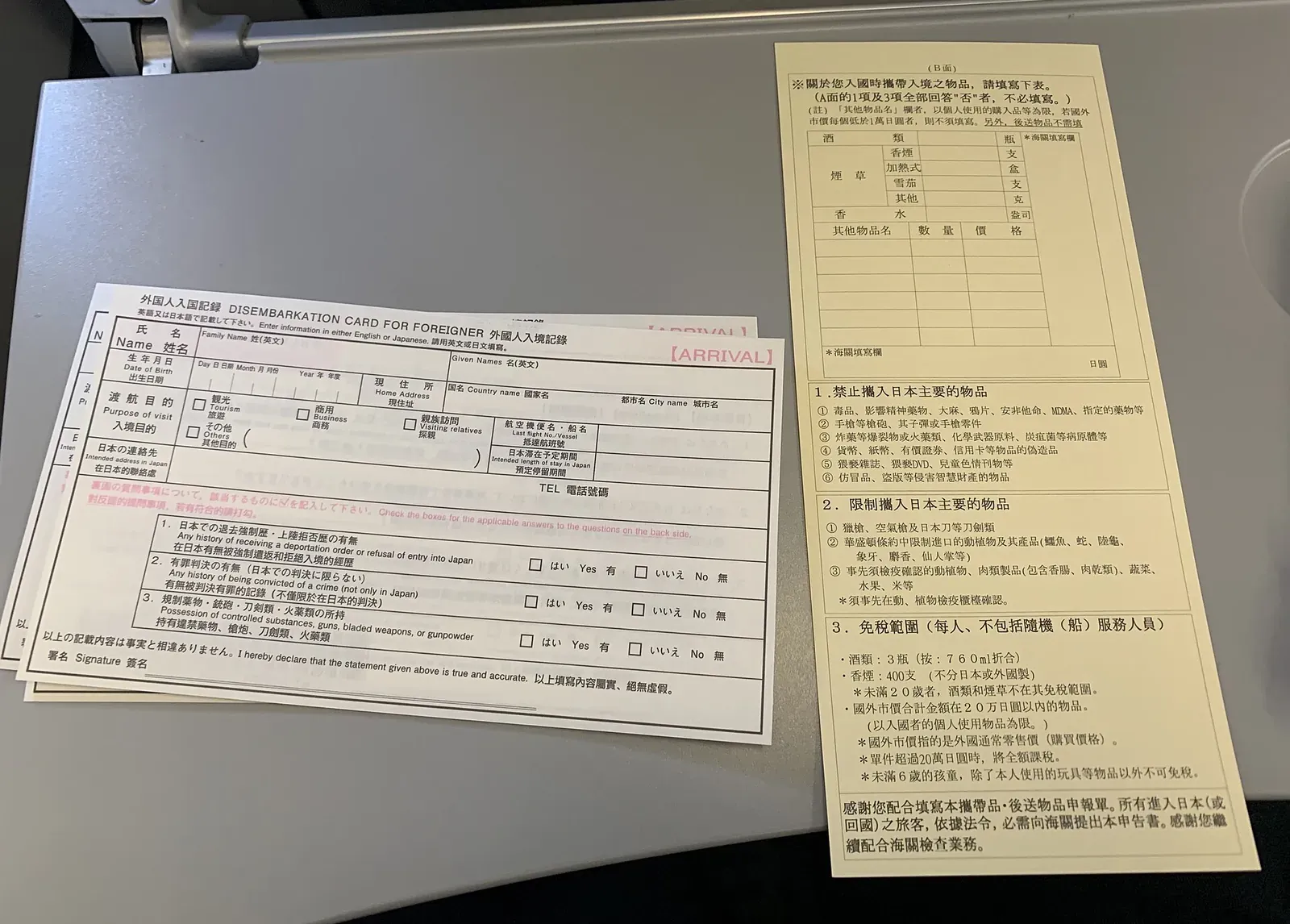
2019 disembarkation cards and customs declarations of Japan
Photo: Nomad112 · Wikimedia Commons
CC BY-SA 4.0 Modified
The declaration card is where the choice actually happens. Tobacco gets its own rows — cigarettes, heated sticks, cigars — and the duty-free allowance is printed directly underneath them.
Exceeding the allowance is not an offence. It is a paid option, and for rare Japanese cigarettes it is often worth taking. Not declaring is the offence.
- United States — the CBP app speeds up the paperwork, but it doesn’t skip anything: you still present your passport and speak to an officer in person, and there’s no way to pay online in advance. Duty applies to the amount above 200.1
- United Kingdom — a genuine exception. Declare and pay online at gov.uk up to 5 days before you travel, and if that’s your only declaration, you walk straight through the Green Channel — no officer, no conversation.320 Remember the charge still covers the whole category if you’re over.
- Australia — tick the tobacco box on the Incoming Passenger Card and use the red channel.6
- New Zealand — declare tobacco on the arrival card whatever the quantity. Disposal bins are available if you would rather abandon the excess.8
- Canada — declare to the CBSA officer, including anything shipped separately.9
- South Africa — you can pre-declare and even pay online in advance, but it doesn’t fully skip the conversation: if what you’ve declared includes anything over the duty-free allowance, the system still routes you to the red channel to finish it with an officer. The online step saves time, not the interaction itself.1821
- Singapore — the other genuine exception. The Customs@SG web application lets you declare and pay duty and GST up to three days before you land, and you walk out through the Green Channel on an e-receipt without necessarily talking to anyone.17 It doesn’t help with a Japanese-bought carton specifically, though — the packaging non-compliance covered above means it gets disposed of at the checkpoint regardless of whether the duty’s been paid.
Two of these — the UK and Singapore — genuinely let you pay ahead and walk past the desk. Everywhere else on this list, an online step (where one exists) speeds up the paperwork but doesn’t replace the conversation with an officer: budget for that rather than assuming you can pre-pay your way past it.
The risk of not declaring is not the duty you avoided. It is seizure of the goods and a penalty on top, and in the countries with prohibitions it can be considerably worse than that.
Where the duty-free cigarettes come from
Everything above is about what you carry home. What Japan itself lets you bring in on the way there is a different set of rules entirely — Japan’s own allowance, the heated-tobacco figures, and a persistent myth about 400 cigarettes for foreign visitors — covered in our guide to bringing tobacco and vapes into Japan.
What it costs to buy in the first place is a separate question too, and the gap is worth knowing before you decide how much to buy.
A carton of Marlboro is ¥4,450 at the duty-free shops at Narita, Haneda, Kansai and New Chitose, against ¥6,200 for the same 200 cigarettes in a Japanese convenience store — about 28% less. The shops sit past passport control on the international side, so you can only reach them on the day you actually fly out. Cigarettes are sold by the carton of ten packs, never singly, and pre-ordering online a few days ahead usually adds a further discount.
For the full price tables, the shop locations at each airport, and how the bulk discounts work, see our guide to duty-free cigarette prices in Japan.
See also
Qatar's Hamad International Airport — a common stopover for travellers connecting through the Gulf — runs its own duty-free tobacco counter with a separate price list, in US dollars and Qatari riyal.
Qatar Duty Free tobacco price list →Frequently Asked Questions
How many cigarettes can I bring home from Japan?
It depends entirely on where you land, not on Japan. The US, UK, Canada, Ireland and South Africa allow 200 cigarettes — one carton. New Zealand allows 50, Australia allows 25, and Singapore gives no duty-free allowance at all.
Can my family pool our tobacco allowances?
No. Each adult traveller has their own allowance and cigarettes are not pooled anywhere in this guide. Three adults flying to the US may carry 200 each, but children add nothing, and the UK, Ireland and South Africa explicitly forbid combining allowances.
What happens if I go over the limit?
You declare the tobacco and pay duty. In the US, Canada, New Zealand, Ireland and South Africa you pay only on the amount above the allowance. In the UK and Australia you pay on the entire quantity, including the part that would have been free.
Does this guide also cover how much tobacco I can bring into Japan?
No — that's a separate question with its own rules, covered in our guide to bringing tobacco and vapes into Japan. This guide is about what you can take home once you land.
Can I take IQOS TEREA sticks home from Japan?
That depends on your destination and it is not an allowance question. Hong Kong and Singapore ban heated tobacco outright, and Australia blocks import without a permit. In those countries it is a prohibited item, seized regardless of quantity.
Why do duty-free cigarettes still get taxed when I arrive in Canada?
Because Canadian duty-free treatment requires the pack to carry the excise stamp 'duty paid Canada droit acquitté'. Japanese duty-free packs do not have it, so a special duty of about C$0.1946 per cigarette applies even inside your 200-cigarette exemption.
Do I have to declare tobacco if I am within the allowance?
Rules vary. New Zealand asks you to declare tobacco on the arrival card whatever the quantity. Most others only require a declaration once you exceed the allowance. When in doubt, use the red channel — declaring costs you duty at worst, while not declaring risks seizure and a penalty.
Is buying duty-free in Japan still worth it with these limits?
For one carton, usually yes — a Marlboro carton is ¥4,450 at the airport against ¥6,200 in a Japanese shop. For Australia and Singapore it is not, because the duty at the other end costs more than the cigarettes did.
Related Guides
Sources
Show all 30 links
Primary documents and reporting this guide is based on.
- 1 US Customs Statement That the Tobacco Exemption Is Limited to 200 Cigarettes and Available Only to Adults Aged 21 and Over Customs Duty Information
U.S. Customs and Border Protection
- 2 US Federal Regulation Setting the 200-Cigarette Ceiling, the Family Grouping Rule and the 30-Day Frequency Limit 19 CFR Part 148 Subpart D — Exemptions for Returning Residents
Electronic Code of Federal Regulations
- 3 UK Government Rules Stating the 200-Cigarette Allowance, the Whole-Category Charge and the Ban on Combining Allowances Bringing goods into the UK for personal use: Arriving in Great Britain
GOV.UK
- 4 HMRC Tariff Notice Setting the Current Minimum Excise Duty per 1,000 Cigarettes Update to Excise Measures – 26 November 2025
HM Revenue & Customs
- 5 UK Legislation Setting the Simplified Traveller Excise Duty Table Used to Charge Excess Cigarettes The Travellers' Allowances and Miscellaneous Provisions (EU Exit) Regulations 2020, Regulation 8
legislation.gov.uk (UK Statutory Instruments)
- 6 Australian Border Force Rules on the 25-Cigarette Concession, Family Pooling and Duty on the Whole Quantity Duty free
Australian Border Force
- 7 Australian Taxation Office's Current Tobacco Excise Duty Rate per Cigarette Stick Excise duty rates for tobacco
Australian Taxation Office
- 8 New Zealand Customs Confirmation of the 50-Cigarette Limit, the Age Requirement and That Duty Applies Only Above the First 50 Duty-free shopping
New Zealand Customs Service
- 9 Canada Border Services Agency Rules on the 200-Cigarette Exemption, the Age-18 Requirement, the Excise Stamp and the Five-Unit Cap Travellers — Alcohol and Tobacco Limits
Canada Border Services Agency
- 10 Canada Revenue Agency's Current Special Duty Rate on Unstamped Traveller's Tobacco EDN105 Adjusted rates of excise duty on tobacco products effective April 1, 2026
Canada Revenue Agency
- 11 Government of Ontario's Current Provincial Tobacco Tax Rate, Used Here to Illustrate the Cost of Exceeding Canada's Personal Exemption Tobacco Tax
Government of Ontario
- 12 Irish Revenue Commissioners' Tobacco Allowance for Arrivals From Outside the EU, and Confirmation That Charges Apply to Goods in Excess of the Allowance Duty-free allowances
Revenue, Irish Tax and Customs
- 13 Irish Revenue Rules Confirming the Minimum Age of 17 and That Allowances Cannot Be Shared Within a Group Duty-free rules
- 14 Singapore Customs Notice That There Is No Duty-Free Concession for Tobacco and That Non-Compliant Packaging Is Destroyed at the Border Duty-Free Concession and GST Import Relief
Singapore Customs
- 15 Singapore Customs' Official Formula and Rate for Calculating Excise Duty on Cigarettes List of Dutiable Goods
- 16 Singapore Ministry of Finance Confirmation of the 20% Tobacco Excise Duty Increase Effective February 2026 H. Fiscal Position — Singapore Budget
Ministry of Finance, Singapore
- 17 Singapore Customs' Own Web Application Letting Travellers Declare and Pay Duty Up to Three Days Before Arrival Customs@SG Web Application
- 18 South African Revenue Service List of Consumable Allowances for Arriving Travellers Arrival in SA
South African Revenue Service
- 19 South African Revenue Service Confirmation That Excess Consumables Are Assessed on the Excess Quantity Only SC-PA-01-03 — Duty Free Allowances for Travellers
- 20 UK Government Confirmation That Paying Duty Online in Advance Lets Travellers Use the Green Channel Without Speaking to an Officer UK customs information: England, Scotland and Wales
- 21 South African Revenue Service Confirmation That Declared Excess Goods Are Still Routed Through the Red Channel Even After an Online Pre-Declaration Travellers
- 22 Hong Kong Customs and Excise Department's Duty-Free Concession of 19 Cigarettes, Deliberately Set Below a Full Pack Duty-free Concessions
Hong Kong Customs and Excise Department
- 23 Hong Kong Customs and Excise Department's Current Cigarette Duty Rate, HK$3,306 per 1,000 Cigarettes Types and Duty Rates
- 24 Hong Kong Government's Own Announcement of the 2024-25 Duty Increase to HK$3.306 per Cigarette, and That Duty-Free Concessions Do Not Apply to Commercial-Quantity Imports LCQ7: Tobacco duty
Government of the Hong Kong Special Administrative Region
- 25 Reporting on Hong Kong's 2024-25 Budget Tobacco Duty Increase and the Resulting Average Pack Price of Approximately HK$94 It's getting more costly for smokers to fund their habit
The Standard (Hong Kong)
- 26 New York State's Legally Mandated Minimum Cigarette Prices for New York City, One of the Country's Highest-Taxed Cigarette Markets Publication 509, Minimum Wholesale and Retail Cigarette Prices for Certain Standard Cigarette Brands
New York State Department of Taxation and Finance
- 27 Tax Foundation Data on US State Cigarette Tax Rates, the Main Driver of the State-to-State Price Range Tobacco Tax Data by State
Tax Foundation
- 28 Hong Kong's Ban on Alternative Smoking Products, Including Heated Tobacco Ban on Alternative Smoking Products
Tobacco and Alcohol Control Office, Hong Kong SAR Government
- 29 Singapore's List of Prohibited Tobacco and Vaping Items, Naming Heated Tobacco Such as IQOS Vaping enforcement
Health Sciences Authority, Singapore
- 30 Australia's Import Restriction on Heat-Not-Burn Devices and Sticks Nicotine, electronic cigarettes and vapes including IQOS devices and heatsticks